.png)

Traditional financing asks the simple question: can this business afford fixed repayments?
Revenue-based financing asks a different one: how will this business actually trade over time?
That distinction changes how underwriting needs to work.
Most underwriting models aren’t built to answer that. They reduce a business to a narrow snapshot – often the last three months of performance – and extrapolate from there. That approach ignores where a business sits in its trading cycle, how its revenue evolves, and how uncertain that future might be.
For SMEs, volatility is not an exception to the business model. It is the business model.
Which is why underwriting in revenue-based financing is fundamentally a forecasting problem.
How forecasting works at YouLend
At YouLend, underwriting is built around probabilistic forecasting rather than fixed assumptions about future revenue.
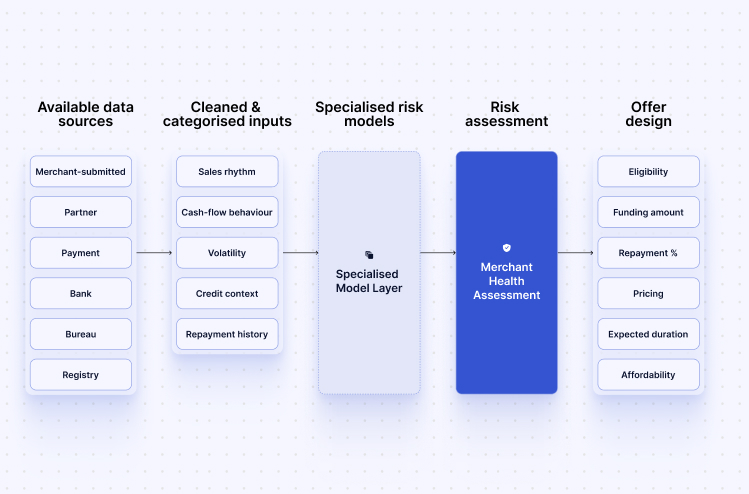
Our forecasting models combine four inputs:
- Merchant revenue history – observed transaction data over time
- Seasonality patterns – industry- and country-level trends derived from our internal data
- Merchant attributes – characteristics (such as business type, size and maturity) that influence stability
- Advanced modelling techniques – how we learn patterns across millions of data points
Together, these inputs allow us to model a range of plausible revenue outcomes rather than projecting a single path. This matters because two merchants with similar recent revenue can carry very different risk profiles depending on their trading patterns, sector dynamics, and revenue stability.
Capturing seasonality
Seasonality is a prime example of why short-term snapshots fail.
For instance, a business applying for funding in September may show strong recent growth ahead of Black Friday. A traditional model might simply extrapolate that trend and miss the predictable dip that follows in January and February.
To capture this, YouLend uses a seasonality index using historical data across industries and geographies. We map each merchant’s profile to relevant patterns, enabling us to adjust forecasts to reflect recurring peaks and troughs, industry-specific trading patterns, and regional differences in demand. This provides crucial context for recent performance.
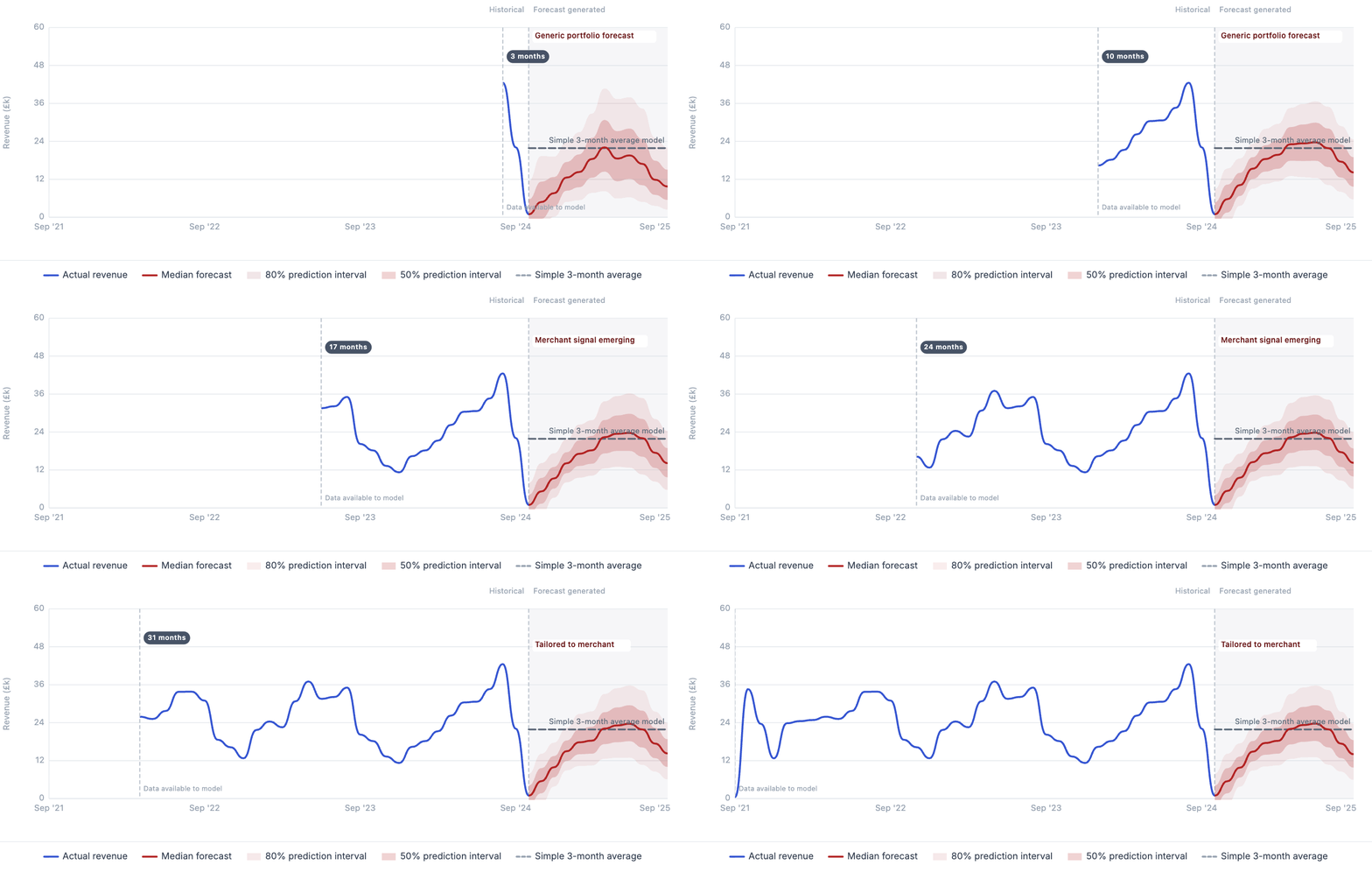
Merchant signal → Stable revenue | Variable / seasonal | −37% uncertainty at 38 months
Phase 1: Portfolio baseline
In the example above, with no merchant history available, the model relies on portfolio-wide seasonality patterns and recent trading behaviour to establish an initial forecast.
-> Advance sizing: conservative and portfolio-led.
Phase 2: Emerging merchant signal
As transaction history accumulates, the forecast begins adapting to the merchant’s own revenue behaviour. Confidence ranges tighten as the model builds a clearer understanding of performance patterns.
-> Advance sizing: confidence-building and increasingly merchant-specific.
Phase 3: Merchant-tailored forecasting
Over time, the model captures the merchant’s individual seasonality, trading cycles, and volatility profile. Forecast precision improves as more behaviour is observed.
Advance sizing: seasonally adjusted and tailored to merchant risk.
Managing risk and uncertainty at scale
SME revenue is inherently variable, and models that treats uncertainty as noise will either misprice risk or decline businesses unnecessarily.
Rather than relying on a single expected revenue estimate, YouLend uses probabilistic forecasting to model a range of plausible outcomes over time. This allows underwriting decisions to reflect both expected performance and the uncertainty surrounding future revenue.
.gif)
Merchant signal ↑ Growing (+2.1%/mo) | Variable / seasonal | −9% uncertainty at 26 months
Phase 1: Portfolio baseline
The model has no merchant history yet, so it relies on portfolio-wide seasonality patterns and recent revenue averages to generate an initial forecast.
-> Advance sizing: conservative.
Phase 2: Emerging merchant signal
As merchant-specific trading data accumulates, the forecast begins moving away from the generic portfolio baseline. Confidence ranges tighten as the model builds a clearer view of the business’s revenue behaviour.
Advance sizing: confidence-building.
Phase 3: Merchant-tailored forecasting
With more trading history, the model captures both growth patterns and revenue variability at the merchant level. Forecasts become increasingly precise as performance signals strengthen over time.
Advance sizing: monitored growth offer.
By modelling uncertainty directly, we can make consistent, automated decisions across a large and diverse portfolio. This approach allows us to:
- Apply more caution where revenue is volatile
- Offer more precise terms where performance is stable
- Scale decisions consistently across a global portfolio
As our dataset grows, the system improves:
- More historical data strengthens seasonality detection
- More outcomes refine our understanding of volatility
- Broader portfolio coverage improves forecasting across sectors and markets
Forecasting as infrastructure
Forecasting is what makes revenue-based underwriting scalable. Demand for funding is rarely evenly distributed throughout the year. Applications often concentrate around major trading periods, when merchants need additional capital for inventory, marketing, or increased customer demand. We have seen financing applications increase by more than 30% ahead of events such as Black Friday.
Underwriting systems therefore need to understand not just how a business performed historically, but how it is likely to behave through different trading cycles and market conditions.
At scale, underwriting stops being a static credit exercise.
At YouLend, it becomes a continuously improving forecasting system built on years of behavioural and repayment data across more than 400,000 merchants, ten markets, and billions in funding volume.
That scale matters. Every repayment event, renewal, and trading cycle improves how the system understands seasonality, volatility, and merchant performance over time — strengthening underwriting decisions across the portfolio.








.jpg)